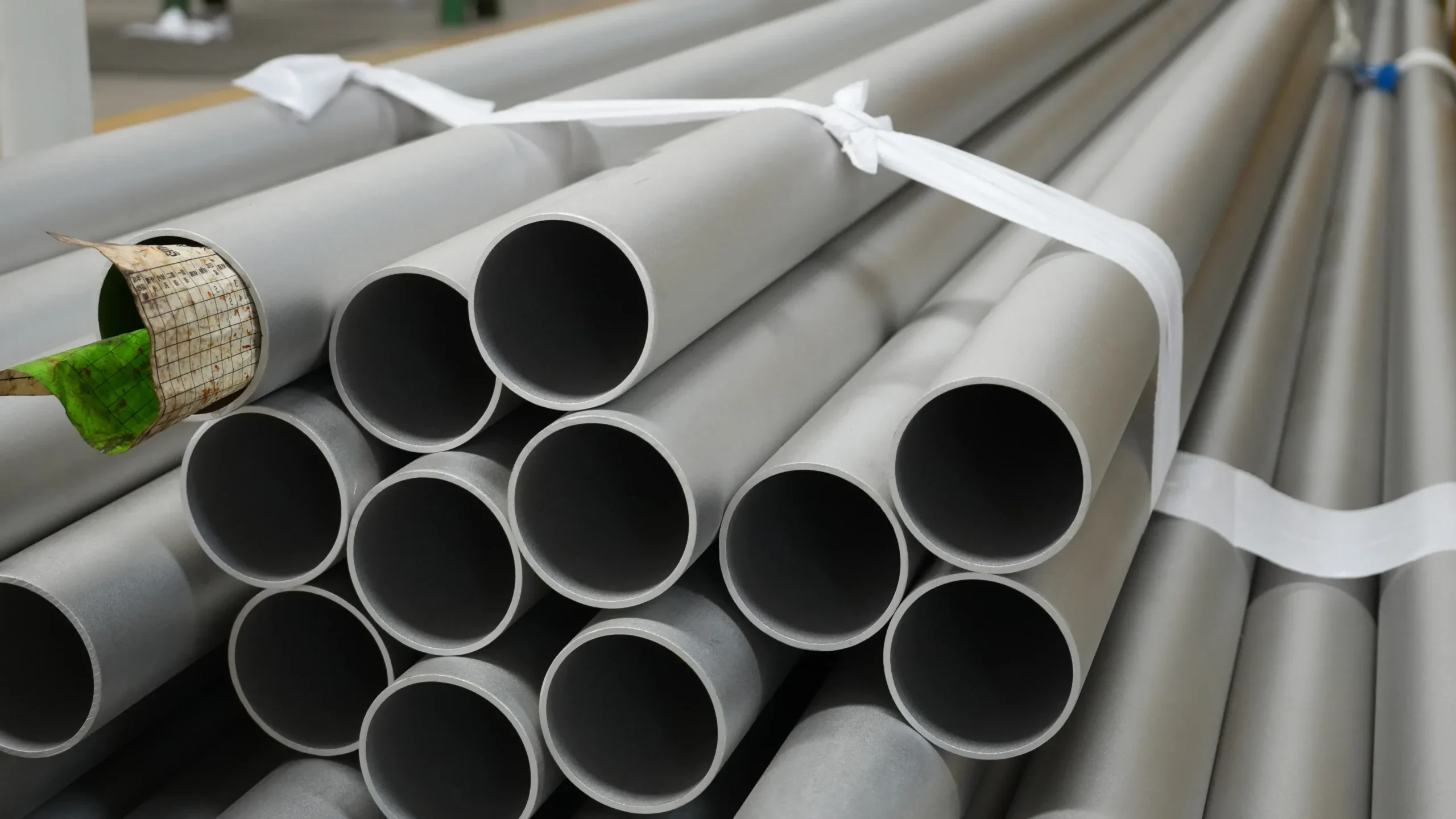
Round Nickel 200/201 Tube
Round Nickel 200/201 Tube is a high-purity,commercially forged nickel product that offers excellent corrosion resistance and high thermal and electrical conductivity.Nickel 200 and Nickel 201 are two distinct grades;however,since their chemical properties are virtually identical,carbon content is the only significant difference between them.We offer round tubes with dual certification.
Specification of Round Nickel 200/201 Tube
| Product | Round Nickel 200/201 Tube |
| Working Temperature | Nickel 200:below 315°C (600°F) Nickel 201:Up to 665 – 677°C (1230 – 1250°F) Nickel 200/201 Dual-certified:Up to 677°C (1250°F) |
| Dimension Range | Outside Diameter (OD): 6 – 200 mm Wall Thickness (THK): 0.35 – 6 mm Length (L): 0.5 – 12 m The size can be customized according to ASME B36.10 / ASME B36.19 |
| Schedules | SCH 5, 10, 40, 80, 160, XXS, XXH |
| Materials | Nickel 200 | UNS N02200 | W.Nr. 2.4060 2.4066 | DIN Ni 99.2 Nickel 201 | UNS N02201 | W.Nr. 2.4061 2.4068 | DIN LC-Ni 99.2 |
| Standards | ASTM B161 / ASME SB161 / ASTM B730 / ASME SB730 / ASTM B163 / ASME SB163 |
| Surface Finish |
Pickled / Descaled Cold Drawn Bright Annealed Satin/Brushed Finish Mirror Polish |
| Corrosion Resistance Specifications |
Excellent Resistance To: Caustic Alkalis Reducing Acids Halogens & Dry Gases Seawater Industrial Chemicals |
| Applications | Chemical Processing Food & Pharmaceutical Energy & Power Electronics Aerospace & Defense Water Treatment |
| Our Strength | Over 10 Years Experience Exporting Pipes & Tubings Stock Available In Common Sizes Customized Fabrication Available Package Supplying of Piping Materials Strict QC With PMI Testing For Every Batch Experience in Exporting to the US,Germany,UAE,etc. Third Party Inspection Available |
For more information on nickel 200/201 tube and other products, please contact us.
Round Nickel 200/201 Tube Chemical Composition (%)
Dual-certified tubing must meet the requirements of both standards;most importantly,the carbon content must comply with the requirements of 201.| Element | Ni(+ Co) | C | Mn | S | Si | Fe | Cu |
| Nickel 200 | ≥ 99.0 | ≤ 0.15 | ≤ 0.35 | ≤ 0.01 | ≤ 0.35 | ≤ 0.40 | ≤ 0.25 |
| Nickel 201 | ≥ 99.0 | ≤ 0.02 | ≤ 0.35 | ≤ 0.01 | ≤ 0.35 | ≤ 0.40 | ≤ 0.25 |
Why are most pipes on the market “dual-certified”?
This is because if the carbon content of the material is kept below 0.02%,it meets both the low-carbon requirements of Nickel 201 and the purity requirements of Nickel 200.As a result,suppliers need only stock one type of material to meet the requirements of both applications.
Does this chemical composition meet food-grade or pharmaceutical-grade standards?
Yes.Because it has an extremely high nickel purity and very few impurities,it does not release harmful metal ions into the fluid,so it is often used in the processing of purity-sensitive substances such as fatty acids and fruit juices.
How does chemical composition affect welding performance?
Because its composition is very similar to that of elemental metals,it does not undergo the complex phase transformations seen in stainless steel during welding.However,extremely high cleanliness must be maintained,as any sulfur- or lead-containing residues on the surface—such as fingerprints or grease—can rapidly cause weld cracks under the high temperatures of the welding process.
Round Nickel 200/201 Tube Mechanical Properties(Typical value range)
The mechanical properties of Round Nickel 200/201 tubes depend primarily on their heat treatment condition (typically annealed).These dual-certified tubes retain the low-carbon characteristics of Nickel 201 while maintaining the excellent mechanical strength of Nickel 200.| Tensile Strength | Yield strength | Elongation | Hardness |
| 380 – 520 MPa (55,000 – 75,000 psi) | 100 – 210 MPa (15,000 – 30,000 psi) | 40% – 55% | 45 – 65 HRB |
Key Features Explained
Excellent Ductility:
An elongation of over 40% makes this tubing ideal for cold bending,flanging,and deep drawing,with minimal risk of cracking.
Low Yield Ratio:
The yield strength is significantly lower than the tensile strength,providing a wide plastic working range before permanent deformation occurs,which helps absorb mechanical shocks.
Low-Temperature Toughness:
At cryogenic temperatures,this tubing not only remains non-brittle but also exhibits a significant increase in tensile and yield strengths while maintaining excellent impact toughness.
Physical Properties of Round Nickel 200/201 Tube
Density:8.89 g/cm³ (0.321 lb/in³)
Melting Range:1435°C – 1446°C (2615°F – 2635°F)
Specific Heat:456 J/kg · ℃
Poisson’s Ratio:0.31
Magnetic Permeability:Ferromagnetic
Thermal Properties of Round Nickel 200/201 Tube
| Temperature(℃) | Thermal Conductivity (W/m · K) | CTE (μm/m · ℃) |
| 20 | 70.2 | – |
| 100 | 67.1 | 13.3 |
| 200 | 61.3 | 13.9 |
| 300 | 56.2 | 14.3 |
| 400 | 52.1 | 14.8 |
| 500 | 52.3 | 15.2 |
| 600 | 53.6 | 15.6 |
Key Takeaways
High-efficiency Heat Transfer:
At room temperature,the thermal conductivity of Nickel 200/201 is approximately 4.5 times that of 304 stainless steel.Even at high temperatures,its heat transfer efficiency remains significantly higher than that of iron-based alloys.
Curie Point Effect:
Around 360°C,as the material transitions from ferromagnetic to paramagnetic,its thermal conductivity and specific heat capacity experience slight fluctuations (this explains the flat trend in the table between 400°C and 500°C).
Thermal Expansion Stability:
Its coefficient of thermal expansion is similar to that of carbon steel,resulting in relatively low thermal stress caused by temperature differences in multi-metal integrated equipment.
Manufacturing Process for Round Nickel 200/201 Tube
The manufacturing of round alloy 718 tubes is a high-precision process designed to address the material’s extremely high hardness and its tendency to work harden.Depending on the end application,we can provide you with seamless or welded tubes.
Seamless Process
The production of seamless tubes begins with high-purity nickel billets.First,the billets are heated to 1150°C to 1230°C and transformed into rough tube blanks using hot extrusion or rotary piercing technology.
The surface of the hot-worked tube is relatively rough and the wall thickness is substantial;it must then undergo multiple cold-drawing or cold-rolling processes to gradually reduce the diameter and refine the wall thickness,taking advantage of nickel’s excellent ductility.
During cold working,the material undergoes work hardening,necessitating multiple intermediate annealing steps.Finally,the tubing undergoes final annealing in a controlled atmosphere furnace to relieve internal stresses and optimize the grain structure,ensuring it meets the mechanical properties required for dual certification.
Welded Process
Welded tubes begin with high-quality nickel sheets or strips.First,the nickel strips are precisely slit to match the circumference of the target tube diameter,and then formed into a circular shape using a continuous roll forming machine.Welding is typically performed using TIG or plasma welding,with self-fusion welding carried out under an inert gas shield to ensure that the chemical composition of the weld seam is identical to that of the base material.
After welding,in-line equipment is used to skim or flatten the inner and outer welds,ensuring a smooth transition between the weld zone and the base material.To eliminate the heat-affected zone and enhance weld strength,the tubes typically undergo further cold reduction and final annealing.
Finishing & Testing
Whether manufactured using seamless or welded processes,formed nickel tubes must undergo rigorous post-processing.First,the surface scale is removed through acid pickling,or a clean,silvery-white surface is achieved through bright annealing.Subsequently,the tubes undergo precision straightening to ensure straightness and are cut to the lengths specified by the customer.
Prior to delivery,all tubes must pass a series of non-destructive tests,including eddy current testing to inspect for surface defects,ultrasonic testing to verify internal integrity,and hydrostatic testing to confirm their pressure-bearing safety in chemical environments.Throughout the entire process,a clean environment must be strictly maintained to prevent contamination by impurities such as sulfur or lead,thereby avoiding the formation of hot cracks during welding or heat treatment.
Can Round Nickel 200/201 tubes be welded? What precautions should be taken?
It is highly suitable for welding,typically using TIG or MIG welding.The surface must be thoroughly cleaned before welding.Nickel is highly sensitive to sulfur (S),lead (Pb),and phosphorus (P).If grease,fingerprints,or chalk marks remain on the surface,they can cause “hot cracks” under the high temperatures of welding.It is recommended to degrease the surface using a solvent such as acetone.
What are the advantages of Round Nickel 200/201 tubes over stainless steel tubes?
Alkali Resistance:
When handling high-concentration,high-temperature sodium hydroxide (caustic soda),nickel tubing has a significantly longer service life than stainless steel.
Resistance to Chloride-Induced Stress Corrosion Cracking (SCC):
Stainless steel is prone to sudden cracking in chloride-containing environments,whereas high-purity nickel is virtually immune to this phenomenon.
Thermal Conductivity:
Its thermal conductivity is approximately 4.5 times that of stainless steel,making it more suitable for use in heat exchangers.
How to Choose Between Seamless and Welded Round Nickel 200/201 tubes?
Seamless Tubes:
Typically used for high-pressure applications (meeting ASME pressure class requirements),critical process piping,or heat exchanger tubes requiring extremely high reliability.
Welded Tubes:
Lower cost,shorter production lead times,and more uniform wall thickness;suitable for medium- and low-pressure fluid transport or large-diameter decorative/structural applications.
write to us
Have a Question?
Contact Us!
Should you have any questions regarding stainless steel pipes, including manufacturing processes, chemical composition or other unfamiliar matters, our staff will be happy to assist you.